
Chemistry
Liquid vs Aqueous
 Liquid is a state of matter that has no fixed shape but has a definite volume. An aqueous solution is a solution in which a substance is dissolved in water. |
Element vs Compound
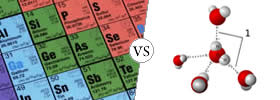 Elements are pure chemical substances that have one or one type of atom. Compounds are chemical substances that are formed from one or more elements, held together by chemical bonds. |
Metals vs Nonmetals
 Metals are solid at room temperature, highly conductive of heat and electricity and are malleable and ductile in nature. Non-metals can be solid, liquid or gaseous at room temperature, and are not conductive,... |
Celsius vs Kelvin
 Celsius, also known as centigrade, is a commonly used unit system that is used to measure the temperature. The Kelvin scale was proposed by William Thomson, 1st Baron Kelvin in 1848. He proposed developing an... |
Iodine vs Iodide
 Iodine is a chemical element with symbol I and atomic number 53. Iodine gains one electron in order to become an iodide ion (I- ion). |
Pages
 |
 |
 |
 |
 |
 |
 |
 |